
VISIOINK KNOWLEDGE CENTER
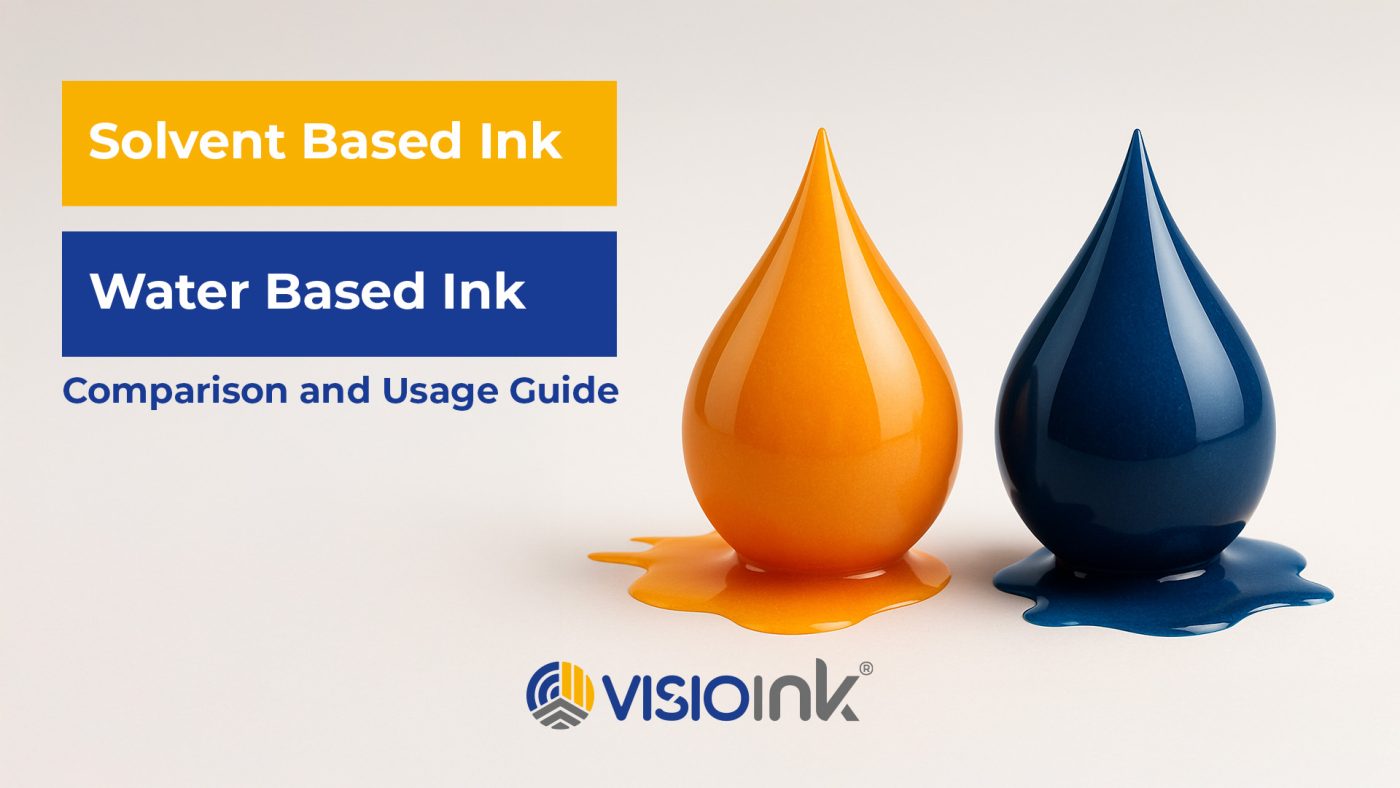
Solvent-Based Inks vs Water-Based Inks:
Which One Should Be Used and When?
Ink technologies used in production processes directly affect print quality, product durability, and application performance. Solvent-based and water-based inks offer different advantages for different surfaces, production conditions, and applications.
VISIOINK CARTRIDGES
Find the Right Ink for Your Application
Explore our Solvent Base, Water Base Standard, and Water Base Deep Black cartridge solutions.
EXPLORE PRODUCTSEXPERT SUPPORT
Which Ink Should You Choose?
Share your printing surface and production conditions with us; together, we can determine the cartridge solution best suited to your application.
CONTACT USSOLVENT-BASED INK
What Is Solvent-Based Ink?
Solvent-based ink is a printing solution produced using chemical solvents that provides strong adhesion on challenging surfaces.
01
Fast Drying
Thanks to its very fast drying properties, it is suitable for use in high-volume production processes.
02
Non-Porous Surfaces
Provides strong adhesion on non-porous surfaces such as plastic, metal, and glass.
03
High Durability
Used for prints that need to withstand water, sunlight, heat, and chemicals.
04
Vibrant Printing
Provides strong printing performance in applications where bright and intense colors are required.
Solvent-based inks can be used in various applications, including food packaging, pharmaceutical and medical product labels, outdoor advertising, and the coding of plastic and metal parts. They are particularly preferred for applications requiring high durability.
WATER-BASED INK
What Is Water-Based Ink?
Water-based ink is a type of ink that uses water as its carrier and provides effective printing performance, particularly on absorbent surfaces.
01
Low VOC
Its low VOC content provides an advantage in applications aimed at reducing environmental impact.
02
Porous Surfaces
Provides high print quality on absorbent surfaces such as paper and cardboard.
03
Cost-Effective Use
In suitable applications, it can be used as an economical and efficient printing solution.
04
Natural Colors
Allows natural tones to be achieved in indoor printing applications.
Water-based inks are particularly used for printing books, magazines, and brochures, as well as for cardboard packaging and indoor advertising materials.
COMPARISON
Differences Between Solvent-Based and Water-Based Ink
Both ink technologies provide advantages under different production conditions. When making the right selection, the printing surface, durability requirements, drying time, and environmental conditions should be evaluated together.
| Feature | Solvent-Based | Water-Based |
|---|---|---|
| Drying Time | Very fast | Relatively slow |
| Durability | Suitable for demanding outdoor conditions | Ideal for indoor use |
| Surface Compatibility | Plastic, metal, glass | Paper, cardboard |
| Environmental Impact | Contains VOCs | More environmentally friendly |
| Cost | Relatively high | Lower |
| Color Quality | Bright and vibrant | Natural tones |
SELECTION CRITERIA
Comparison of Advantages and Disadvantages
SOLVENT-BASED
Advantages
• Resistant to demanding conditions.
• Provides strong adhesion on non-porous surfaces.
• Suitable for outdoor applications.
Disadvantages
• Has a higher environmental impact due to VOC emissions.
• Costs may be higher.
WATER-BASED
Advantages
• An environmentally friendly and sustainable option.
• Lower cost.
• Provides high print quality on porous surfaces.
Disadvantages
• May provide limited performance in outdoor applications.
• Performance may decrease on non-porous surfaces.
INDUSTRY APPLICATIONS
Which Ink Is Used in Which Industry?
The areas of use for solvent-based and water-based inks vary depending on the printing surface and production conditions.
Food Industry
Solvent-based ink can be preferred for plastic bottles, while water-based ink can be used for cardboard boxes.
Pharmaceutical Industry
Selecting an ink suitable for the surface is important for DataMatrix, barcode, and variable data printing.
Printing Industry
Water-based inks stand out in applications involving absorbent surfaces such as books and magazines.
Advertising
Solvent-based solutions can be used for outdoor applications, while water-based solutions can be used for indoor applications.
FREQUENTLY ASKED QUESTIONS
Frequently Asked Questions About Solvent-Based and Water-Based Inks
01
Is solvent-based ink harmful to health?
Due to VOC emissions, appropriate safety precautions should be taken during use. It should be used in accordance with industrial standards.
02
Can water-based ink be used outdoors?
Its performance may be limited in applications exposed to moisture and sunlight. It is generally preferred for indoor applications and absorbent surfaces.
03
Which ink is more economical?
Water-based inks are generally less expensive. However, when evaluating total cost, the durability requirements of the print and the application conditions should also be taken into account.
VISIOINK SOLUTIONS
The Right Ink, the Right Surface, Reliable Printing
Both solvent-based and water-based inks offer different application advantages. When long-term durability and performance on non-porous surfaces are required, solvent-based solutions stand out; for absorbent surfaces such as paper and cardboard, water-based solutions are more suitable.
When selecting the right cartridge, surface structure, production speed, drying time, print quality, and operating environment should be evaluated together.
EXPLORE CARTRIDGES CONSULT AN EXPERTCHOOSE THE RIGHT INK
Find the Most Suitable Cartridge for Your Application
Explore VISIOINK solvent-based and water-based cartridge solutions to determine the option best suited to your printing surface.